
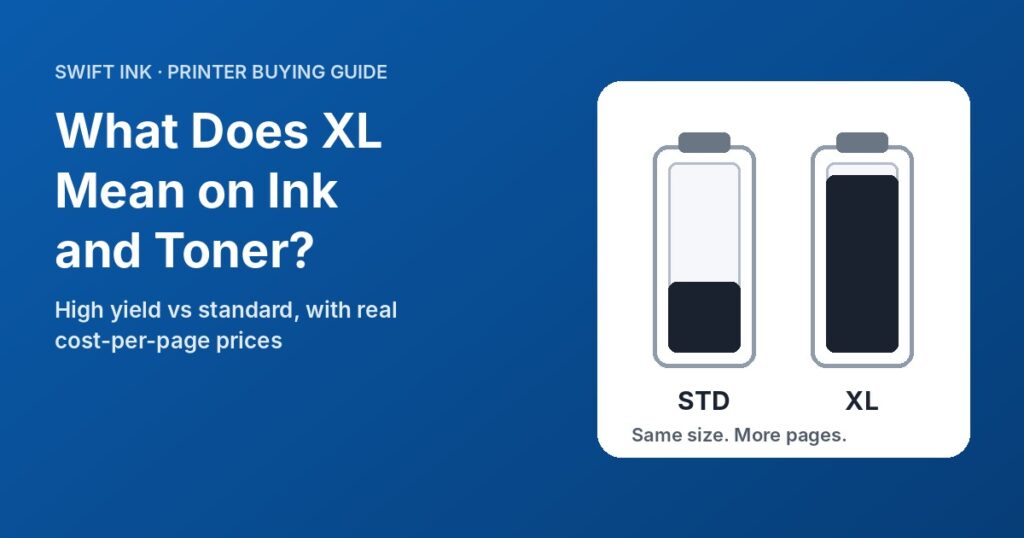
XL on an ink cartridge means high yield: the same cartridge, filled with more ink, rated to print more pages. Toner works the same way under different names, such as HP’s “X” and Brother’s “XL”, “XXL” and “UXXL”. This guide decodes the labels, shows real prices for standard and high-yield cartridges side by side, and tells you when the bigger one is worth it.
Quick answer
- XL means high yield. An XL or high-yield cartridge holds more ink or toner and is rated for more pages. It fits the same printers as the standard one, as long as your printer lists it.
- It almost always costs less per page. A compatible HP 148X toner prints 9,500 pages for $68.99 (0.73¢ a page). The standard 148A prints 2,900 for $59.99 (2.07¢ a page).
- For toner, buy the biggest size your printer takes. Toner doesn’t dry out in the printer, so a high-yield cartridge only saves money.
- For ink, buy XL if you print every week or two. If you print a few pages a month, ink can dry in the nozzles before you use it up, so a standard cartridge may waste less.
- XXL, X, H and UXXL are bigger sizes, not different parts. Check your printer’s supplies list before you buy, because the largest sizes don’t fit every model in a family.
What does XL mean on ink cartridges and toner?
XL stands for extra large, and printer makers use it to mean high yield. HP says it marks high-yield inkjet cartridges with the letters XL after the model number, and that a high-yield cartridge has a larger ink chamber than the standard one. The cartridge looks the same from the outside and goes in the same slot. It just has more inside.
“Yield” is the number of pages a cartridge is rated to print. Brands measure it with ISO test standards: ISO/IEC 24711 for inkjet cartridges and ISO/IEC 19752 for black laser toner (19798 for color toner). HP prints a fixed set of five mixed text and graphics pages, over and over, until the print fades. That makes yields fair to compare between cartridges, even though your own page count will differ.
Standard cartridge
Lower price at the register. Fewer pages, so a higher cost per page. Example: compatible HP 138A, 1,500 pages.
XL or high-yield cartridge
Same outside size, more inside. Costs a little more, prints a lot more. Example: compatible HP 138X, 4,000 pages.
Why the box number and your count differ: HP notes that text-heavy pages, printing a few pages at a time, and the ink a printer uses at setup all lower real yield. Our guide to how long toner lasts explains page yield and coverage in more detail.
XL, X, H, XXL: high-yield names by brand
Every brand labels sizes a little differently. Use this table to read the part number on your cartridge. The letters mean the same cartridge family in a bigger size, not a different printer.
| Brand and type | Standard | High yield | Bigger sizes |
|---|---|---|---|
| HP ink | No letter (HP 63) | XL (HP 63XL) | None on most models |
| HP toner | A (HP 148A) | X (HP 148X) | Y, extra high yield, on some LaserJet Enterprise models |
| Brother toner | No letter (TN830, TN920) | XL (TN830XL, TN920XL) | XXL super high and UXXL ultra high (TN920XXL, TN920UXXL) |
| Brother ink | No letter (LC401) | XL (LC401XL) | XXL on some INKvestment models |
| Canon ink | No letter (PG-275) | XL (PG-275XL) | XXL (PGI-280XXL) |
| Canon toner | No letter (069) | H (069H) | None on most models |
| Epson ink | No letter (822) | XL (822XL) | None on most models |
| Lexmark toner | 0 in the 5th place on many models (56F1000) | H (56F1H00) | X extra high, U ultra high (56F1X00, 56F1U00) |
Brother’s own toner pages show how big the steps get. The TN920 is rated for 3,000 pages, the TN920XL for 6,000, the TN920XXL for 11,000 and the TN920UXXL for 18,000, all under ISO/IEC 19752. The TN830 is rated for 1,200 pages and the TN830XL for 3,000.
High yield vs standard toner: what it really costs
Here are compatible HP toners we sell in both sizes, with the price, the rated yield and the cost per page. In every pair, the high-yield cartridge costs $5 to $10 more and prints two to three times as many pages.
| Cartridge | Fits | Price | Yield (pages) | Cost per page |
|---|---|---|---|---|
| Compatible toner for HP 134A | HP LaserJet M209dw, MFP M234dw/sdw, M235sdw | $34.99 | 1,100 | 3.18¢ |
| Compatible high-yield toner for HP 134X | Same printers | $39.99 | 2,400 | 1.67¢ |
| Compatible toner for HP 138A | HP LaserJet Pro 3001dw, MFP 3101fdw/sdw | $48.99 | 1,500 | 3.27¢ |
| Compatible high-yield toner for HP 138X | Same printers | $58.99 | 4,000 | 1.47¢ |
| Compatible toner for HP 148A | HP LaserJet Pro 4001dn and others | $59.99 | 2,900 | 2.07¢ |
| Compatible high-yield toner for HP 148X | Same printers | $68.99 | 9,500 | 0.73¢ |
The 148 pair shows it best. An office printing 10,000 pages would spend about $207 on standard 148A cartridges, or about $73 on high-yield 148X. That’s $134 saved for the same pages, plus fewer cartridge changes.
Brand-name toner follows the same pattern
Brother’s own prices step down the same way as the cartridges get bigger. The table below uses Brother’s listed prices and yields next to our compatible versions. For the TN830 and TN920 families we stock only the high-yield sizes.
| Size | Yield (pages) | Brand-name price | Brand-name per page | Swift Ink compatible |
|---|---|---|---|---|
| TN830 standard | 1,200 | $60.99 | 5.08¢ | Not stocked; buy the XL |
| TN830XL high yield | 3,000 | $98.29 | 3.28¢ | $32.99, 1.10¢ per page |
| TN920 standard | 3,000 | $95.49 | 3.18¢ | Not stocked; buy the XL |
| TN920XL high yield | 6,000 | $128.29 | 2.14¢ | $39.99, 0.67¢ per page |
| TN920XXL super high yield | 11,000 | $204.29 | 1.86¢ | $48.99, 0.45¢ per page |
| TN920UXXL ultra high yield | 18,000 | $241.49 | 1.34¢ | $59.99, 0.33¢ per page |
Two things stand out. Going from the TN920 to the TN920UXXL cuts the brand-name cost per page by more than half. And a compatible high-yield cartridge often costs less than the brand-name standard one while printing more pages. For more brand-name vs compatible numbers across 43 printers, see our printer ink cost study.
Is XL ink worth it?
Usually, yes, with one condition: you have to use it before it dries. The math favors XL just like toner. HP rates the HP 63 black for about 190 pages and the HP 63XL black for about 480, so one XL does the work of about two and a half standard cartridges. Our remanufactured HP 63XL black is $16.99 for those 480 pages (swiftink.com, November 2026).
The catch is time. HP says that when you print infrequently, ink can dry up inside the cartridge, and that standard cartridges can be more practical for low-volume printing. Epson’s manuals say to use up an ink cartridge within six months of opening the package. Toner has no such problem in the printer, which is one reason laser printers suit offices that print in bursts. Our laser vs inkjet cost comparison runs those numbers.
A rule of thumb for ink: if you’d use up a standard cartridge in less than a couple of months, buy the XL. If a standard cartridge lasts you more than six months, the XL may dry out before it pays off. Printing a page every week or two keeps the nozzles from drying either way.
Which size should you buy?
Answer these three questions in order. Most office laser printers end at the first or second one.
-
Does your printer’s supplies list include a high-yield version?
- Yes
- Go to question 2.
- No
- Buy the standard cartridge. Some printers, especially entry models, take only one size.
-
Is it a laser printer (toner) or an inkjet (ink)?
- Laser
- Buy the largest size your printer lists. You’ll pay less per page and change cartridges less often.
- Inkjet
- Go to question 3.
-
Will you use up the XL within about six months?
- Yes
- Buy the XL.
- No
- Buy the standard size, or print a page every week or two so the ink keeps flowing.
Not sure how many pages you print? Our printer cost per page calculator shows what each size costs you per month.
Will an XL cartridge fit my printer?
In most cases, yes. The standard and high-yield versions of a cartridge share a slot, and printers that take both list both part numbers in the manual and on the brand’s supplies page. Check three things before you order.
- The biggest sizes don’t fit every model. Brother lists the TN920XXL for 20 printers, including the HL-L5210DW and MFC-L5710DW. The TN920UXXL page lists 12 printers, and those two aren’t among them. Always match the exact cartridge to your exact model.
- Your first cartridge may be smaller. HP notes that some printers ship with a smaller introductory cartridge, so the first one runs out sooner than any replacement you buy.
- HP printers ending in “e”. HP+ printers accept only original HP cartridges, whatever the size. Read what the “e” means before you buy for one.
Watch out: a high-yield cartridge for a different series won’t fit just because the letters match. A TN830XL and a TN920XL are different cartridges for different printers. Match the number first, then pick the size.
If you’re still choosing a printer, cost per page matters more than the sticker price. See our ranking of the best black and white laser printers by cost per page.
Frequently asked questions
What does XL mean on ink cartridges?
XL means high yield. The cartridge holds more ink than the standard version and is rated to print more pages. It fits the same printers as the standard cartridge, as long as your printer lists it.
Is XL ink worth it?
Yes, if you’ll use it before it dries. XL ink costs less per page, but if you print only a few pages a month, ink can dry in the cartridge first. Epson says to use a cartridge within six months of opening it.
What is the difference between high yield and standard toner?
High-yield toner holds more toner in the same cartridge shape, so it prints more pages per cartridge. A compatible HP 138X prints 4,000 pages versus 1,500 for the 138A, for $10 more. Toner doesn’t dry out in the printer, so high yield is the better buy whenever your printer takes it.
What does the X mean on HP toner?
On HP LaserJet toner, A is the standard yield and X is the high yield. For example, the HP 148A is rated for 2,900 pages and the 148X for 9,500. Some LaserJet Enterprise models also have a Y cartridge with extra high yield.
Is XXL better than XL?
XXL holds more than XL, so it usually costs less per page. Brother’s TN920XXL is rated for 11,000 pages versus 6,000 for the TN920XL. The bigger sizes don’t fit every printer, so check your model’s supplies list first.
Why did my XL cartridge print fewer pages than the box says?
Yields come from a standard test page set, not your documents. Text-heavy pages, printing a few pages at a time, and cleaning cycles all lower the count. A starter cartridge that came with the printer also holds less.